3D Concrete Printers
Robotic 3D concrete printing systems
Industrial 3D concrete printers engineered for continuous production — from raw silo to finished layer, on one automated line. MiCoB designs, manufactures and operates the complete system: the six-axis robot cell, the dry-mix handling plant, the continuous wet mixer, the pump, the extruder and the slicing software.
Construction, rebuilt around the robot
Every element of the line is developed and integrated in-house. The result is a single, controlled process chain: raw material enters at the silo, and a finished, dimensionally accurate structure leaves the print bed.
No third-party handoffs, no mismatched interfaces, no unknowns between the mix design and the nozzle.
Three systems. One printing platform.
All three MiCoB systems share the same six-axis robot cell, extruder architecture, progressive-cavity pumping and slicing software. What separates them is how much of the material plant is automated — so the machine can be matched to the scale, the site and the budget.
Field-proven, not prototype
The systems have delivered defence structures, multi-storey dwellings and commercial buildings under live project conditions and public-sector scrutiny.
Built for continuous output
Continuous wet mixing and progressive-cavity pumping remove the batch cycle from the critical path. The robot prints while the plant keeps feeding it.
Minimum manpower
Automated dosing, conveying, mixing and extrusion mean a full commercial line runs with a small skilled crew rather than a conventional site workforce.
How to read the rangeAtri automates the wet side and keeps dry-mix feeding manual — the lowest-footprint entry into robotic printing. Agastya adds a reversible drum mixer and intermediate silo so dry batching is mechanised on site. Sushrut closes the loop with full silo storage and conveying, giving uninterrupted production at plant scale.
Flagship
MiCoB Sushrut
Commercial 3D concrete printer — fully automated.
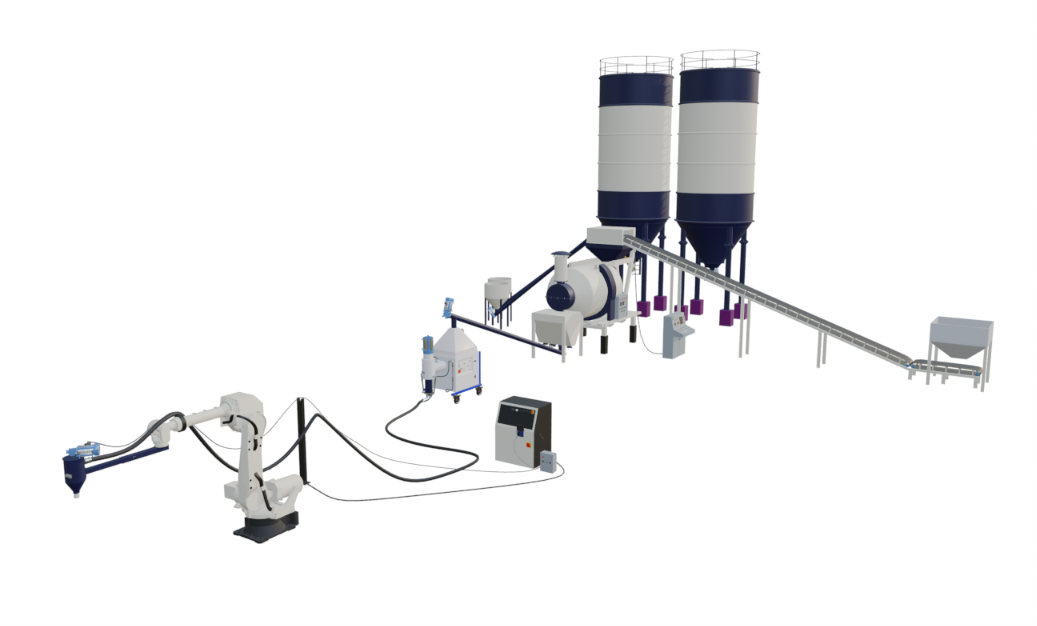
The Sushrut is the complete production line. Cement, fly ash and additive silos feed an aggregate hopper through belt, screw and pneumatic conveying into a reversible drum mixer. Dry material passes through an intermediate silo with dust collection to the automated feeding chamber, where continuous wet mixing and progressive-cavity pumping deliver material to the extruder at the robot's end effector — without a single manual transfer.
Key characteristics
- Silo-to-nozzle automation: dosing, conveying, dry mixing, wet mixing, pumping and extrusion all under machine control.
- Dedicated cement, fly ash and additive silos with belt and screw / pneumatic conveying for uninterrupted supply.
- Reversible drum mixer with intermediate silo and dust collector for clean, consistent dry batching.
- Automated continuous wet mixing chamber paired with a progressive-cavity screw pump for stable flow.
- Six-axis robot on base-plate mounting with reach extension for large-envelope printing.
Technical specification
| Utility | Commercial 3D concrete printer — fully automated |
|---|---|
| Controlled axes | 6 |
| Maximum payload | 125 kg — suitable for larger extruder system mounting |
| Motion range (r, Z) | r 2,655 mm (3,905 mm with reach extension), Z 2,800 mm |
| Repeatability | ±0.5 mm |
| Max printing speed | Up to 25 m/min |
| Layer height | 10 – 20 mm |
| Layer width | 20 – 80 mm |
| Max aggregate size | 3 mm |
| Material input type | Dry pre-mix (MiCoB Shield® 3D) |
| Dry material storage | Cement silo, fly ash silo and additive silo with aggregate hopper |
| Conveying (plant side) | Belt conveyor with screw / pneumatic conveying |
| Dry mixing | Reversible drum mixer |
| Intermediate storage | Intermediate silo with dust collector |
| Wet mixing | Automated continuous mixing and pumping |
| Standard material flow | 5 – 30 l/min, depending on worm pump |
| Conveying distance | Up to 40 m |
| Conveying height | Up to 15 m |
| Conveying pressure | Up to 25 bar |
| Feeding hopper | 100 litres |
| Extruder | Mounted at end effector |
| Reach extension | Yes |
| Slicer software | MiCoB Slicer and Simulator |
| Output | 2 tonnes / hour |
| Power supply | 440 kW, 3 phase |
| Manning | 3 skilled operators, 1 helper |
| Printer setup time | 7 days |
Commercial
MiCoB Agastya
Commercial 3D concrete printer — semi-automatic.
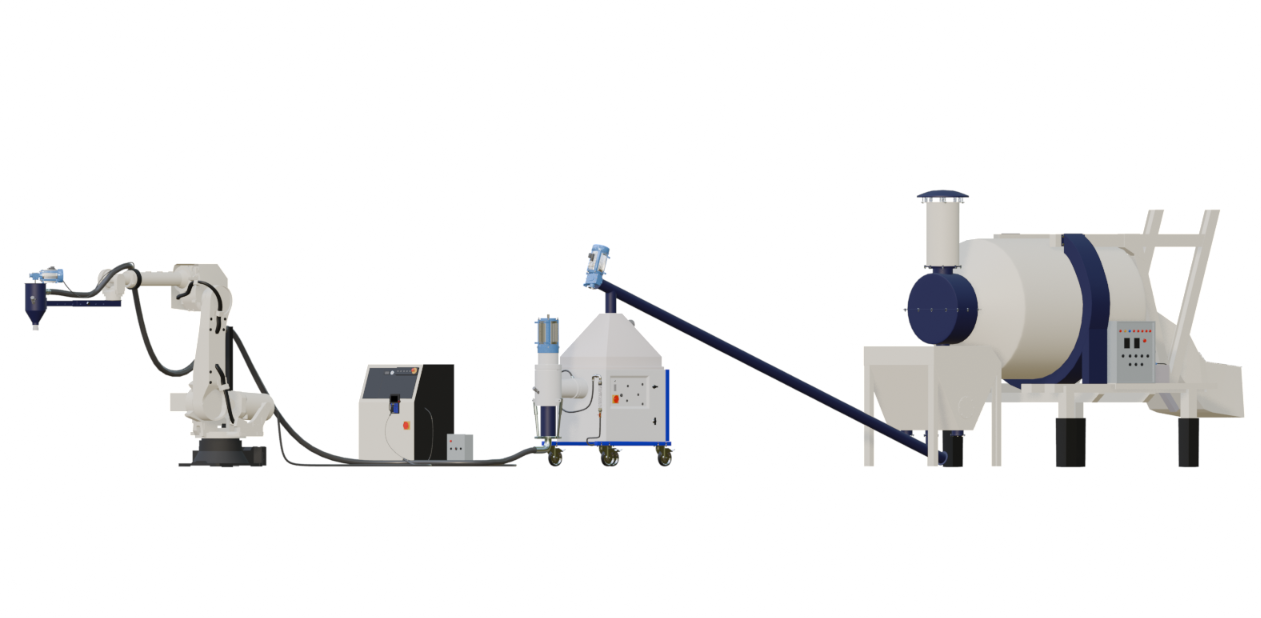
The Agastya carries the same robot cell and printing performance as the flagship, with a compact material plant built around a mobile reversible drum mixer. Dry raw material is fed through load-cell bins, dry-mixed, conveyed by screw to an intermediate silo with dust collection, then continuously wet-mixed and pumped to the extruder. It is the practical choice for commercial on-site printing where a full silo farm is neither needed nor welcome.
Key characteristics
- Reversible drum mixer with 400 L drum capacity, mounted on a mobile chassis for site relocation.
- Dry raw material feeding bins with load cells for controlled, repeatable batching.
- Screw conveyor to an intermediate silo with dust collector, feeding the automated material chamber.
- Automated continuous wet mixing and pumping through a progressive-cavity screw pump.
- Output of up to 2 tonnes per hour, subject to worm pump selection and material.
Technical specification
| Utility | Commercial 3D concrete printer — semi-automatic |
|---|---|
| Controlled axes | 6 |
| Maximum payload | 125 kg — suitable for larger extruder system mounting |
| Motion range (r, Z) | r 2,655 mm (3,905 mm with reach extension), Z 2,800 mm |
| Repeatability | ±0.5 mm |
| Max printing speed | Up to 25 m/min |
| Layer height | 10 – 20 mm |
| Layer width | 20 – 80 mm |
| Max aggregate size | 3 mm |
| Material input type | Dry pre-mix (MiCoB Shield® 3D) |
| Dry mixing | Reversible drum mixer, 400 L drum capacity |
| Dry material feeding | Feeding bins with load cell |
| Intermediate storage | Intermediate silo with dust collector |
| Wet mixing | Automated continuous mixing and pumping |
| Output | Up to 2 tonnes / hour, depending on worm pump and material |
| Standard material flow | 5 – 30 l/min, depending on worm pump |
| Conveying distance | Up to 40 m |
| Conveying height | Up to 15 m |
| Conveying pressure | Up to 25 bar |
| Feeding hopper | 100 litres |
| Extruder | Mounted at end effector |
| Reach extension | Yes |
| Slicer software | MiCoB Slicer and Simulator |
| Power supply | 440 kW, 3 phase |
| Manning | 3 skilled operators, 3 helpers |
| Printer setup time | 7 days |
Entry
MiCoB Atri
Commercial 3D concrete printer — automated continuous wet mixing, manual dry-mix feeding.
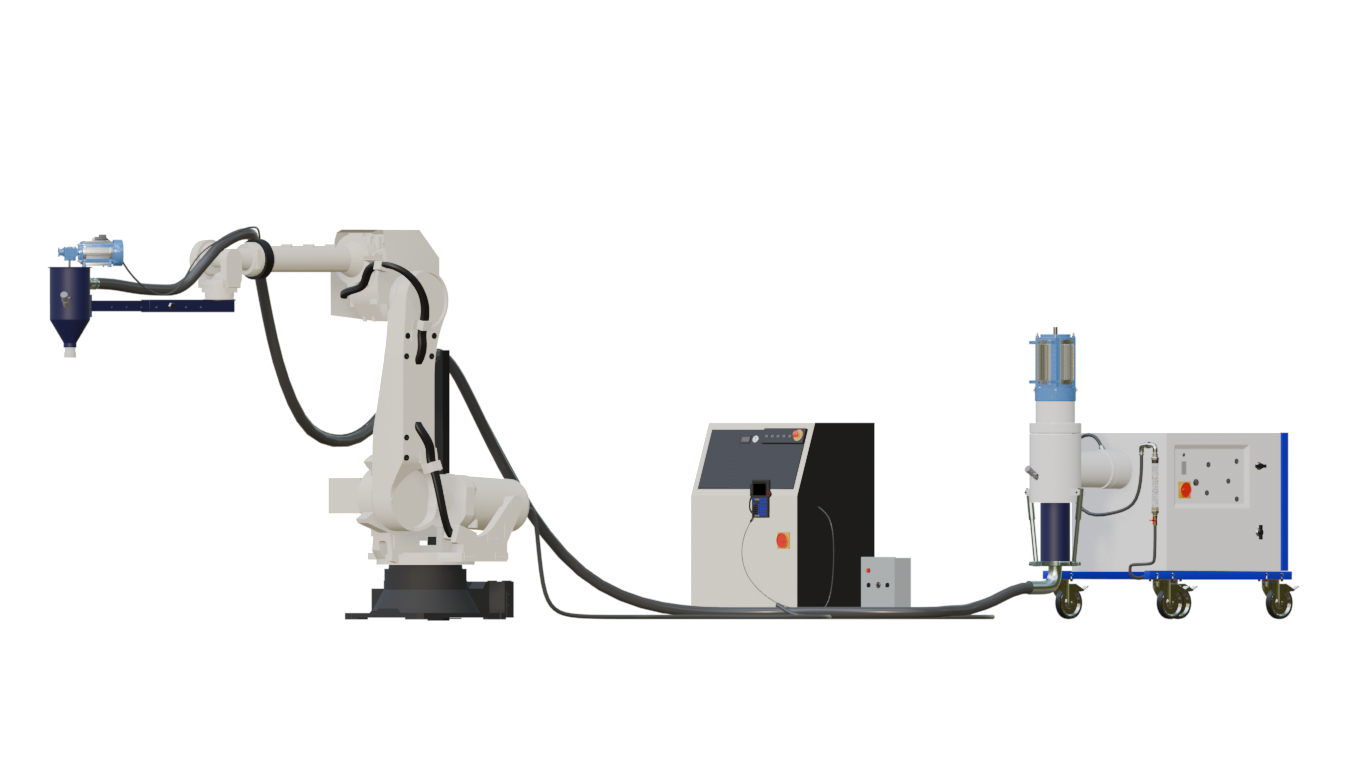
The Atri strips the line down to its essentials. Pre-blended dry mix is loaded manually into the material hopper; from there the automated continuous wet mixing chamber and progressive-cavity screw pump take over, delivering material through the conveying hose to the extruder. Same robot, same print quality, smallest possible footprint — ideal for precast yards, R&D cells and constrained sites.
Key characteristics
- Automated continuous wet mixing chamber — consistent water dosing and mix quality without batch cycling.
- Manual dry-mix feeding via material hopper: no silos, no conveyors, minimal site preparation.
- Progressive-cavity screw pump with concrete conveying hose to the end-effector extruder.
- Six-axis robot on base-plate mounting with reach extension — identical print envelope to the larger systems.
- Fastest system to install, commission and relocate.
Technical specification
| Utility | Commercial 3D concrete printer — automated continuous wet mixing, manual dry-mix feeding |
|---|---|
| Controlled axes | 6 |
| Maximum payload | 125 kg — suitable for larger extruder system mounting |
| Motion range (r, Z) | r 2,655 mm (3,905 mm with reach extension), Z 2,800 mm |
| Repeatability | ±0.5 mm |
| Max printing speed | Up to 25 m/min |
| Layer height | 10 – 20 mm |
| Layer width | 20 – 80 mm |
| Max aggregate size | 3 mm |
| Material input type | Dry pre-mix (MiCoB Shield® 3D) |
| Dry mixing | Manual — pre-blended dry mix loaded to material hopper |
| Wet mixing | Automated continuous mixing and pumping |
| Pumping | Progressive-cavity screw pump |
| Standard material flow | 5 – 30 l/min, depending on worm pump |
| Conveying distance | Up to 40 m |
| Conveying height | Up to 15 m |
| Conveying pressure | Up to 25 bar |
| Feeding hopper | 100 litres |
| Extruder | Mounted at end effector |
| Reach extension | Yes |
| Slicer software | MiCoB Slicer and Simulator |
| Power supply | 440 kW, 3 phase |
| Manning | 2 skilled operators, 5 helpers |
| Printer setup time | 7 days |
Compare the range
| Feature | MiCoB Atri | MiCoB Agastya | MiCoB Sushrut |
|---|---|---|---|
| Automation level | Automated wet mixing | Automated dry + wet | Fully automated line |
| Dry-mix feeding | Manual, via hopper | Reversible drum mixer, 400 L | Silo-fed, conveyed |
| Raw material storage | — | Feeding bins with load cell | Cement, fly ash & additive silos |
| Wet mixing | Continuous, automated | Continuous, automated | Continuous, automated |
| Intermediate silo | — | With dust collector | With dust collector |
| Robot | 6-axis, 125 kg payload | 6-axis, 125 kg payload | 6-axis, 125 kg payload |
| Extruder mounting | End effector | End effector | End effector |
| Reach extension | Yes | Yes | Yes |
| Best suited to | Precast yards, compact sites | Commercial on-site printing | High-volume production |
Working envelope
- Radial envelope (r): 2,655 mm from the base centre line, extended to 3,905 mm with the MiCoB reach extension.
- Vertical envelope (Z): 2,800 mm print height above the mounting surface, with the envelope continuing 370 mm below it.
- J1 rotation of 370° revolves the full envelope about the base — a near-complete circular print field from a single setup.
- Repeatability of ±0.5 mm across the envelope.
- Conveying up to 40 m horizontally and 15 m vertically lets the material plant sit well clear of the print area.
The two halves of a printable structure
A printer is only as good as what flows through it and what tells it where to go. MiCoB develops both.
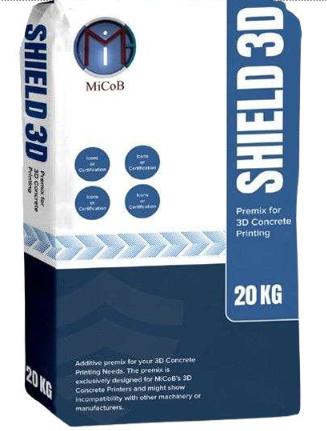
Material
MiCoB Shield® 3D
A dry pre-mix formulated specifically for extrusion printing — engineered for pumpability at pressure, immediate green strength and reliable interlayer bonding.
Maximum aggregate size of 3 mm supports layer widths from 20 to 80 mm and layer heights from 4 to 20 mm, giving control over surface finish and build rate.
Software
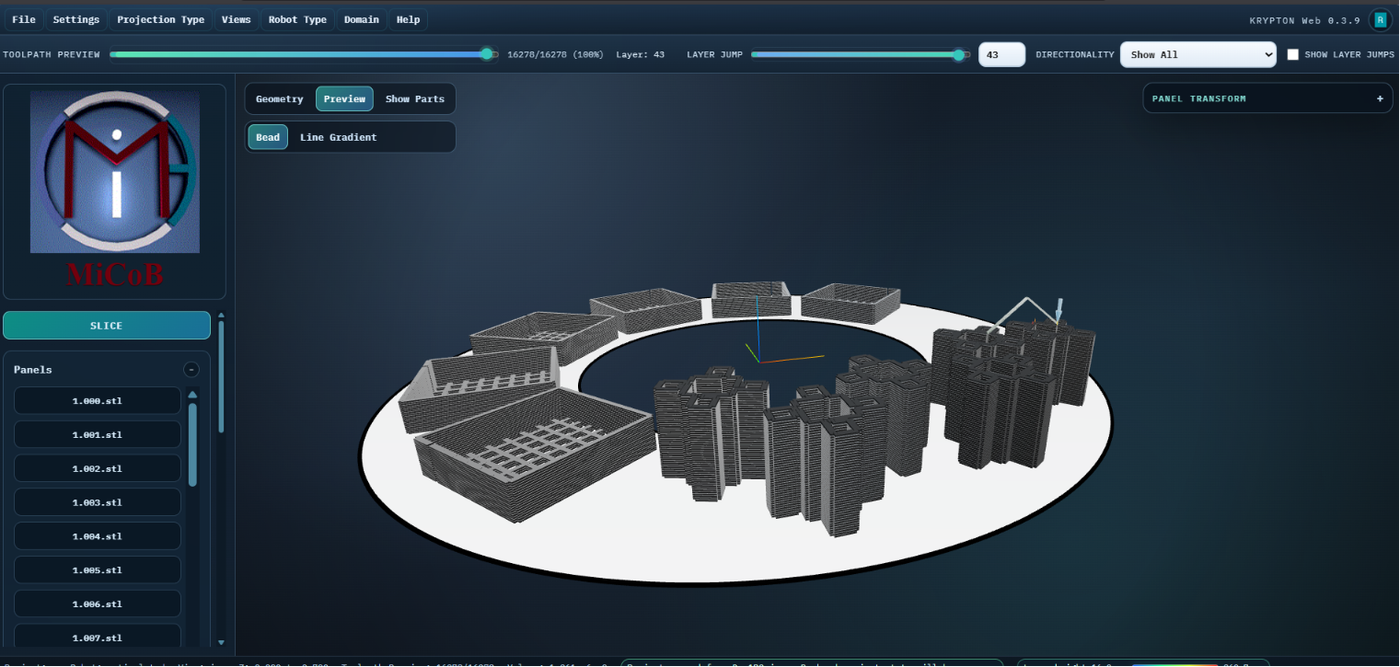
MiCoB Slicer & Simulator
Purpose-built slicing for six-axis robotic extrusion — not adapted desktop FDM software. Toolpaths are generated with the robot's reach and singularities in view.
Full simulation before a single kilogram of material is mixed: collision checking, reachability and print-time estimation on the actual cell.
Let's print the future.
Talk to us about system specification, site assessment, operator training or a printed pilot structure for your project.
Specifications are indicative and subject to change without notice.
Planning a project or a system?
Tell us what you want to build — we route your enquiry to the right team.